AI Citation SEO: 2026 Guide for Local Businesses
AI SEO, Local Business Marketing, 2026 Guide
AI Citation SEO: Why Clicks Don’t Matter Anymore (2026 Guide for Local Businesses)
Search is being rewritten by AI. For local businesses, the real fight in 2026 is no longer for blue links and clicks, but for something new: AI citations—the mentions and links AI assistants use when they answer your customers’ questions for you.
What Is AI Citation SEO, in Plain English?
When someone asks Google’s AI Mode, ChatGPT, or Perplexity, “Who’s the best dentist near me?” the AI doesn’t just guess. It pulls from web pages, reviews, local listings, and articles—and then cites the sources it trusts most. That mention, link, or brand reference is an AI Citation.
AI Citation SEO is the practice of shaping your Search Engine Optimization and digital marketing to ensure AI systems repeatedly choose your business as a trusted source in their answers. Think of it as ranking inside the AI answer box, not just on the traditional results page.
Why Clicks Don’t Matter (As Much) Anymore
For years, SEO lived and died by clicks. Higher click-through rate, more traffic, more leads—simple. But AI answer experiences are breaking that model. Users increasingly get their answers without ever clicking through to a website. One report found that organic click-through rates dropped by more than 60% for queries with AI Overviews, and paid CTR fell even further as AI modules took center stage.
At the same time, brands that win AI citations are seeing a surge in AI search referrals—some reporting over 500% growth in AI-driven visits—despite fewer total clicks from traditional search results. In other words, the old metric of “how many people clicked my blue link?” is being replaced by a deeper one: how often does AI recommend my business?
📌 Key Takeaway: In 2026, clicks are a lagging indicator. Your real goal is to become the business AI assistants talk about, not just the one users occasionally click.
The 2026 SEO Landscape: From Keywords to AI Conversations
Several big SEO trends explain why AI Citation SEO is now critical for local businesses:
Google’s AI Mode now cites Google.com itself in over 17% of AI responses, and most of those citations point to organic result pages, not just local listings. Ranking organically feeds directly into AI visibility.
Research on Generative Engine Optimization (GEO) shows that answer-first content and expert quotes can boost AI visibility by up to 40%, and well-structured, data-rich pages are cited far more often by AI assistants.
Freshness matters: over 70% of pages cited by ChatGPT have been updated within the last year, and recently updated content is several times more likely to be used as a source.
For a local café, law firm, or HVAC company, this means your AI SEO strategy must go beyond keywords. You’re optimizing for how AI reads, understands, and quotes your content in live conversations with your potential customers.
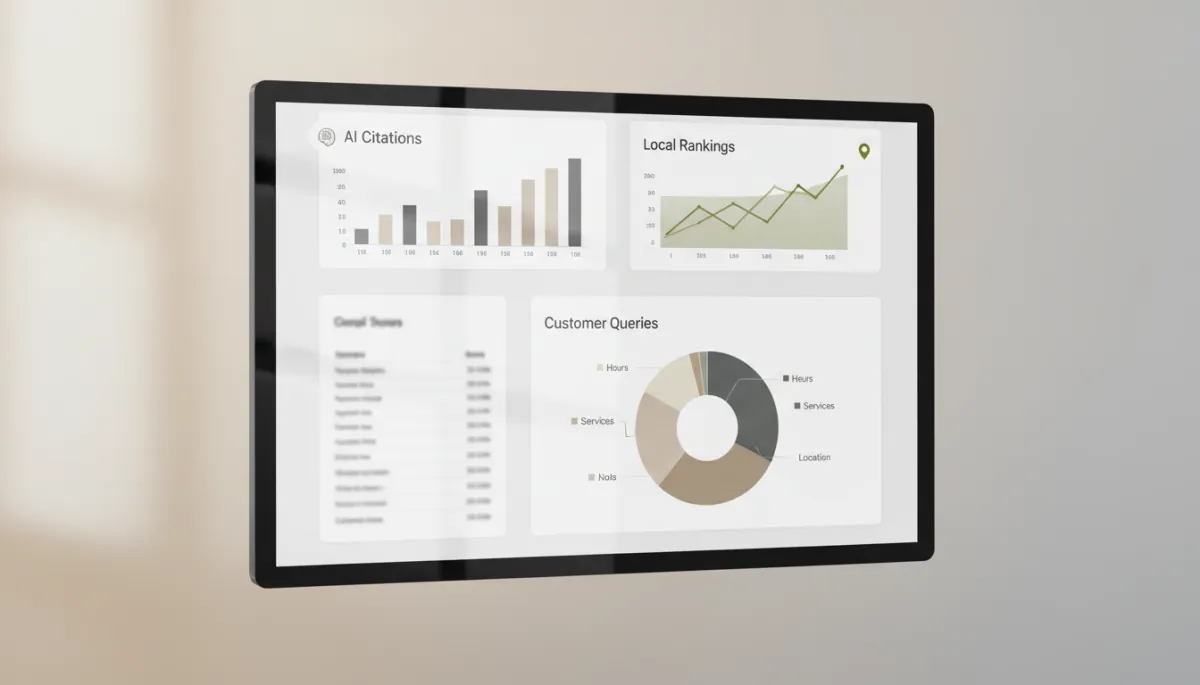
Tracking AI citations alongside rankings reveals how often assistants actually recommend your brand.
AI Citations vs. Clicks: What Really Drives Local Customers?
If clicks are down, should you still care about them? Yes—but differently. Think of Clicks Importance in 2026 like this:
Clicks are still a useful signal of interest and help search engines judge relevance. They remain part of core search engine optimization and ranking algorithms.
But AI assistants now “filter” those clicks. Users often see just a handful of AI-cited businesses instead of ten blue links. If you’re not on that short list, you may never get the chance to earn the click.
Traffic from AI referrals is lower in volume but higher in quality—studies show that AI-referred visitors stay longer and convert far better than standard organic traffic.
For local businesses, the question is shifting from “How many people clicked my listing?” to “How often does AI shortlist my business, and how many of those recommendations turn into calls, bookings, or foot traffic?”
Building an AI SEO Strategy for Local Businesses in 2026
To compete in this new environment, you need an AI SEO strategy that blends traditional search engine optimization with AI-focused tactics. Here’s a practical roadmap tailored to local businesses.
1. Start with Local Authority Fundamentals
Keep your Google Business Profile complete, accurate, and active—photos, posts, Q&A, and up-to-date hours all feed AI systems.
Build consistent NAP (name, address, phone) citations across directories, maps, and industry sites; AI leans heavily on this structured data for local answers.
Encourage detailed, keyword-rich reviews—AI often quotes real customer language when summarizing your business.
2. Create Answer-First, AI-Friendly Content
Generative engines reward content that is easy to quote. That’s where your AI content marketing strategy comes in. Instead of generic blog posts, publish pages that:
Lead with a clear, concise answer to a specific question local customers ask (e.g., “How much does an emergency plumber cost in [City]?”).
Include simple tables, bullet points, and price ranges that AI can easily lift into its own response.
Add expert quotes from your team (“Our lead dentist recommends…”) and local statistics, which research shows significantly increase the odds of a citation.
💡 Pro Tip: Turn your phone FAQs into a structured “Local Answers” hub on your site. These pages are perfect targets for AI citations.
3. Use AI to Power Your Own Content Engine
AI isn’t just something you optimize for; it’s a tool you can use to execute your AI content marketing strategy faster and smarter:
Analyze call transcripts, chat logs, and reviews with AI to uncover real customer language and recurring questions to target in content.
Draft first versions of service pages, FAQs, and blog posts with AI, then refine them with your local knowledge and personality.
Use AI tools to test different titles and meta descriptions to sustain healthy CTR, even as impressions shift into AI modules.
4. Refresh and Diversify Your Presence
AI assistants pull from a surprisingly wide range of platforms: websites, YouTube, Reddit, review sites, and more. To maximize your AI Citation footprint:
Regularly update key pages—service pages, pricing, location pages, and FAQs—so they remain “fresh” in AI models’ eyes.
Repurpose content into short videos with clear titles and transcripts; Google’s AI Overviews and YouTube both feed into AI answers.
Participate in local forums, community groups, and Q&A platforms; AI often surfaces these community voices when answering hyperlocal questions.
Measuring Success: New Metrics for AI Citation SEO
If clicks aren’t the whole story, how do you know your AI SEO strategy and digital marketing efforts are working in 2026? Look beyond basic traffic reports and track:
AI Presence Rate: How often do AI assistants mention or recommend your brand when you test relevant questions?
Citation Authority: On how many different pages and platforms is your business being cited or quoted as an expert?
AI Referral Conversions: Track leads tagged from “AI answers” or “assistant referrals” (many analytics tools now support this) and compare their quality to standard organic leads.
Combined with traditional rankings and CTR, these metrics give you a fuller picture of how visible and persuasive your business is in AI-driven search.
Turning AI Citation SEO into a Competitive Advantage
Most local competitors are still chasing yesterday’s playbook—obsessing over rankings and raw clicks while ignoring how AI actually answers customers’ questions. By embracing AI Citation SEO now, you can:
Become the “default” recommendation AI assistants give in your area and niche.
Generate fewer, but far more qualified, visits that drive calls, bookings, and store visits.
Future-proof your digital marketing against ongoing shifts in SEO trends and AI search experiences.
The 2026 reality is clear: clicks still matter, but they are no longer the star of the show. For local businesses, the real power lies in being the business AI trusts enough to cite—again and again—whenever your customers ask for help.
Start by tightening your local fundamentals, then build an AI content marketing strategy that answers real questions, showcases your expertise, and stays fresh. Do that consistently, and you won’t just chase clicks—you’ll own the conversations that create customers long before they ever touch a browser tab.