Market Your Contracting Business Locally in the USA
Marketing, Contractor Marketing, Local SEO
How to Market a Contracting Business in the United States: A Practical Local Guide
Winning new jobs as a contractor in the United States is no longer just about word-of-mouth and yard signs. Homeowners and commercial clients now search online, compare reviews, and even use AI-powered tools before they ever pick up the phone. This guide walks you through modern contractor marketing, from Local SEO and Google Business Profile to AI search optimization and online reputation management, so your business gets found and chosen in your local market.
Why Contractor Marketing Has Changed in the U.S.
Ten years ago, a contracting business could thrive on referrals, truck wraps, and local print ads. Today, potential clients pull out their phones, type “roofing contractor near me,” or ask an AI assistant which local electrician is most trusted. If your company does not appear in those results, you are invisible to a huge share of the market, no matter how skilled your crew is.
Effective contractor marketing now blends traditional tactics with digital strategies like Local SEO, AI search optimization, and strong online reputation management. The good news: you do not need a big-city agency or a massive budget. You just need a focused plan tailored to how local customers in the United States actually search and decide.
Step 1: Define Your Ideal Local Customer and Service Area
Before you spend a dollar on contractor marketing, get crystal clear on who you serve and where you want to work. A residential remodeling contractor in a suburban U.S. city will market very differently from a commercial HVAC company in a dense urban area or a rural excavation business covering several counties.
Identify your top three money-making services (for example: kitchen remodels, roof replacements, concrete driveways).
Define your preferred service radius in miles or ZIP codes around your office or home base.
Clarify your ideal customer type: homeowners, property managers, real estate investors, or small businesses.
This clarity will shape your Local SEO strategies, your ad targeting, and even the language you use on your website and profiles. Search engines and AI tools reward relevance, so the more specific you are, the easier it is to match you with the right local searches.
Step 2: Build a Conversion-Focused Contractor Website
Your website is the digital storefront for your contracting business. It does not have to be fancy, but it must be clear, trustworthy, and easy to use on a phone. Many U.S. homeowners will decide whether to call you in less than 10 seconds of landing on your site.
Use plain, local-focused headlines: “Residential Roofing Contractor in Denver, CO” is better than “Welcome to Our Site.”
Display your phone number, service area, and license/insurance information prominently on every page.
Add clear calls to action: “Request a Free Estimate” or “Schedule a Site Visit.”
Showcase photos of real projects, before-and-after shots, and short customer testimonials with city names.
To support AI search visibility and Local SEO, include simple, descriptive text on each service page. For example, “We provide asphalt shingle roof replacements for single-family homes in Phoenix, Scottsdale, and Mesa” tells search engines exactly what you do and where you do it, which helps you appear in more relevant local searches and AI-generated answers.
Step 3: Optimize Your Google Business Profile for Local SEO
For contractors in the United States, your Google Business Profile (GBP) is just as important as your website—sometimes more. It powers your presence in Google Maps, the local “3-pack” results, and even AI-driven summaries that appear when people search for local services. An optimized profile is a cornerstone of strong Local SEO and contractor marketing.
Claim and verify your profile. Make sure your business name, address, and phone number (NAP) are accurate and consistent with your website and other listings.
Choose the right primary category. Use specific categories like “Roofing contractor,” “General contractor,” or “HVAC contractor,” not just “Construction company.”
Add detailed services and descriptions. List your main services and include city names in a natural way: “Bathroom remodeling in Austin and surrounding areas.”
Upload professional photos. Show your team, vehicles, job sites, and finished projects. Local customers and AI ranking systems both favor profiles that look active and real.
Post updates regularly. Use Google Posts to share seasonal offers, safety updates, or recent projects. Frequent updates can boost your visibility and engagement.
A complete, active Google Business Profile sends strong signals to both traditional search algorithms and newer AI systems about your relevance, location, and trustworthiness—key ingredients for high AI search visibility in your local market.

A tuned Google Business Profile can drive a steady stream of high-intent local leads.
Step 4: Use Local SEO Strategies to Dominate Nearby Searches
Local SEO strategies are what help your contracting business show up when people search things like “basement waterproofing in Cleveland” or “licensed electrician near me.” Unlike national SEO, Local SEO is all about proximity, relevance, and reputation in your specific area of the United States.
On-Page Local SEO Basics
Include city and neighborhood names naturally in your page titles, headings, and content: “Concrete Driveway Installation in Boise, Meridian, and Nampa.”
Create separate service-area pages for key cities you serve, with unique content and project examples for each location.
Add your full business name, address, and phone number in the footer of your site and on a dedicated Contact page.
Off-Page Local SEO and Citations
List your business in reputable U.S. directories like Yelp, Angi, HomeAdvisor, Houzz, and local chambers of commerce, keeping your NAP details identical everywhere.
Join neighborhood apps and local Facebook groups where homeowners ask for contractor recommendations, and respond helpfully (without spamming).
Seek backlinks from local partners such as real estate agents, designers, and suppliers who can feature your work on their sites.
These Local SEO strategies not only help you rank in Google’s map and organic results; they also feed accurate, consistent data into AI-powered search tools that increasingly guide local consumer decisions.
Step 5: Embrace AI Search Optimization and AI Search Visibility
AI is changing how people search for contractors. Instead of just typing into a search bar, they ask conversational questions to Google’s AI, Bing Copilot, or voice assistants: “Who is the best-rated deck builder near me?” or “Which local HVAC company offers 24/7 emergency service?” To capture this growing audience, you need to think in terms of AI search optimization and AI search visibility, not just classic SEO.
Write Content That Answers Real Questions
Create FAQ sections on your website that answer common homeowner questions in natural language, such as “How long does a roof replacement take in winter?” or “Do I need permits for a deck in Orlando, FL?”
Publish short blog posts or project spotlights that mention location, project type, and outcome: “We completed a full basement waterproofing project in Buffalo, NY, in under two weeks.”
AI systems crawl this content and use it to generate answers. If your site clearly answers local, project-specific questions, you increase your chances of being recommended when someone in your area asks an AI for contractor suggestions.
Use Structured Data and Clear Service Information
While you may rely on a web professional for technical details, the concept is simple: the clearer your online information, the easier it is for search and AI tools to understand and recommend you. Make sure your website and profiles specify:
Exact services offered (for example: “storm damage roof repair,” “tankless water heater installation,” “ADA-compliant bathroom remodels”).
Service hours, emergency availability, and any guarantees or warranties you provide.
Service areas down to city, neighborhood, or ZIP code where relevant.
Think of AI search optimization as making your contracting business “machine-readable” so that modern tools can confidently match you with the right local jobs.
Step 6: Master Online Reputation Management for Contractors
In contracting, your reputation is your most valuable asset. Online, that reputation is expressed through reviews, ratings, photos, and how you respond to feedback. Strong online reputation management can be the difference between a homeowner calling you or scrolling past to the next contractor with more stars and fresher reviews.
Get More High-Quality Reviews
Ask every satisfied customer to leave a review on Google, and optionally on Yelp or Angi. Make it part of your close-out process, just like final payment and walkthroughs.
Send a simple follow-up text or email with direct links to your review profiles and a short message: “It would mean a lot to our small business if you could share your experience.”
Encourage customers to mention the city and type of project in their review; this can subtly support Local SEO and AI search visibility.
Respond to Every Review—Good or Bad
Thank happy customers by name and reference their project: “We loved working on your kitchen remodel in Tacoma!”
Address negative reviews calmly and professionally. Offer to discuss the issue offline and, when appropriate, explain what you have done to make things right.
Search engines and AI tools heavily weigh review quality, quantity, and recency when ranking local contractors. A strong reputation not only wins over human customers; it also boosts your contractor marketing across platforms by signaling trust and reliability.
Step 7: Combine Online and Offline Marketing for Local Impact
While digital tools like Local SEO and AI search optimization are crucial, traditional tactics still work extremely well for contracting businesses in the United States—especially when you connect them to your online presence.
Use yard signs with your logo, phone number, and website on every job where it is allowed. Neighbors will see your work and look you up online.
Wrap your trucks and vans with clear branding and a simple message: “Licensed Roofing Contractor – Free Estimates – [City Name].”
Sponsor local sports teams, neighborhood events, or charity builds and share photos on your Google Business Profile and social media.
Every offline impression should lead people back to an online space where they can see your reviews, portfolio, and contact options. This blended approach makes your contractor marketing feel familiar and trustworthy while still leveraging the power of Local SEO and online visibility.
Step 8: Track Results and Improve Your Contractor Marketing Over Time
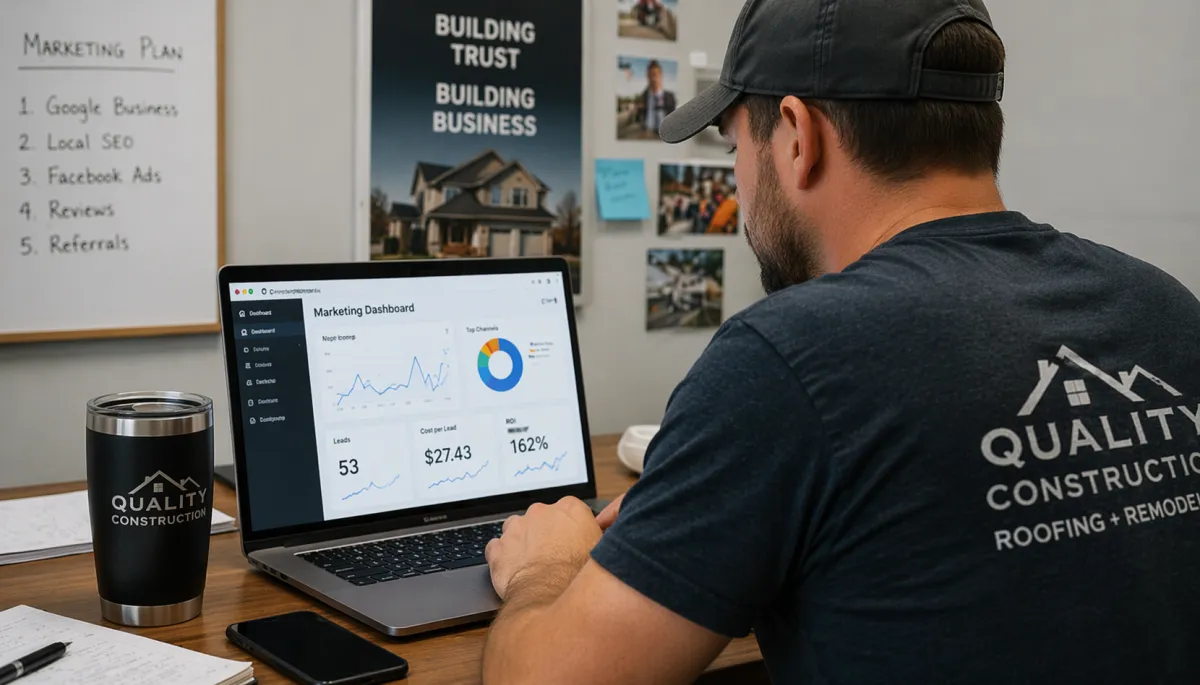
Marketing a contracting business is not a one-time project; it is an ongoing process of testing, measuring, and refining. Fortunately, you do not need complex dashboards to know what is working. A few simple habits can help you make smarter decisions and improve your return on investment over time.
Ask every new lead, “How did you hear about us?” and track responses on a simple spreadsheet or CRM.
Review your Google Business Profile insights monthly to see how many calls, website visits, and direction requests you are getting from search and maps.
Monitor your average review rating and total review count across platforms, aiming for steady growth.
Over time, you will see which contractor marketing channels bring in the most profitable jobs—whether that is Local SEO, AI search visibility, referrals, or a mix. Then you can double down on what works and scale back what does not, keeping your marketing lean and effective.
Turning Modern Marketing into Steady Local Work
Learning how to market a contracting business in the United States can feel overwhelming, especially with all the talk about algorithms, AI, and Local SEO. Yet, at its core, successful contractor marketing is about showing real people—right in your community—that you are reliable, skilled, and easy to work with, then making it simple for them to find and contact you online.
By focusing on a clear service area, a solid website, an optimized Google Business Profile, thoughtful Local SEO strategies, and proactive online reputation management, you build a marketing foundation that works 24/7. Layering in AI search optimization content and consistent review generation ensures that, as search behavior evolves, your business remains visible and competitive in both traditional results and AI-driven recommendations.
Start with one or two steps from this guide—such as fully completing your Google Business Profile and asking every customer for a review—then expand into Local SEO content and AI-friendly FAQs. With steady effort, your contracting business can turn modern marketing into a dependable pipeline of local projects, season after season.